Most loc stylists price by the installation. The stylists who actually scale price by the chair-hour. Those are two very different businesses, and the gap between them is decided long before the client sits down - it is decided by how long the installation physically takes.
1. The Metric That Governs Loc Salon Profit
A loc salon has a fixed number of sellable hours per week. If a studio operates five days and books eight hours per day, that is 40 billable chair-hours - the entire revenue ceiling of the business until you hire. Every pricing decision is really a decision about how much revenue each of those hours produces.
This is why two stylists charging the same ticket price can finish the year in completely different positions. The one installing in six hours earns more per chair-hour than the one installing in ten, even though the client pays the same amount.
2. Where Traditional Dread Installs Lose Money
Traditional dreadlock installation is labour-dense by design. The stylist sections the hair, backcombs each section into a base, then builds structure by hand - and the client is in the chair for all of it. The material itself is usually the cheap part of the job.
That labour profile creates three problems:
- Low daily capacity. One long installation can consume an entire working day, so a single reschedule wipes out a full day of revenue.
- Inconsistent tension. Hand-built bases vary between sections, which shows up later as uneven retightening intervals and client complaints.
- Slow onboarding. New stylists take even longer, so the salon cannot add capacity without the owner personally doing the work.
3. How Pre-Interlocked Locs Change the Math
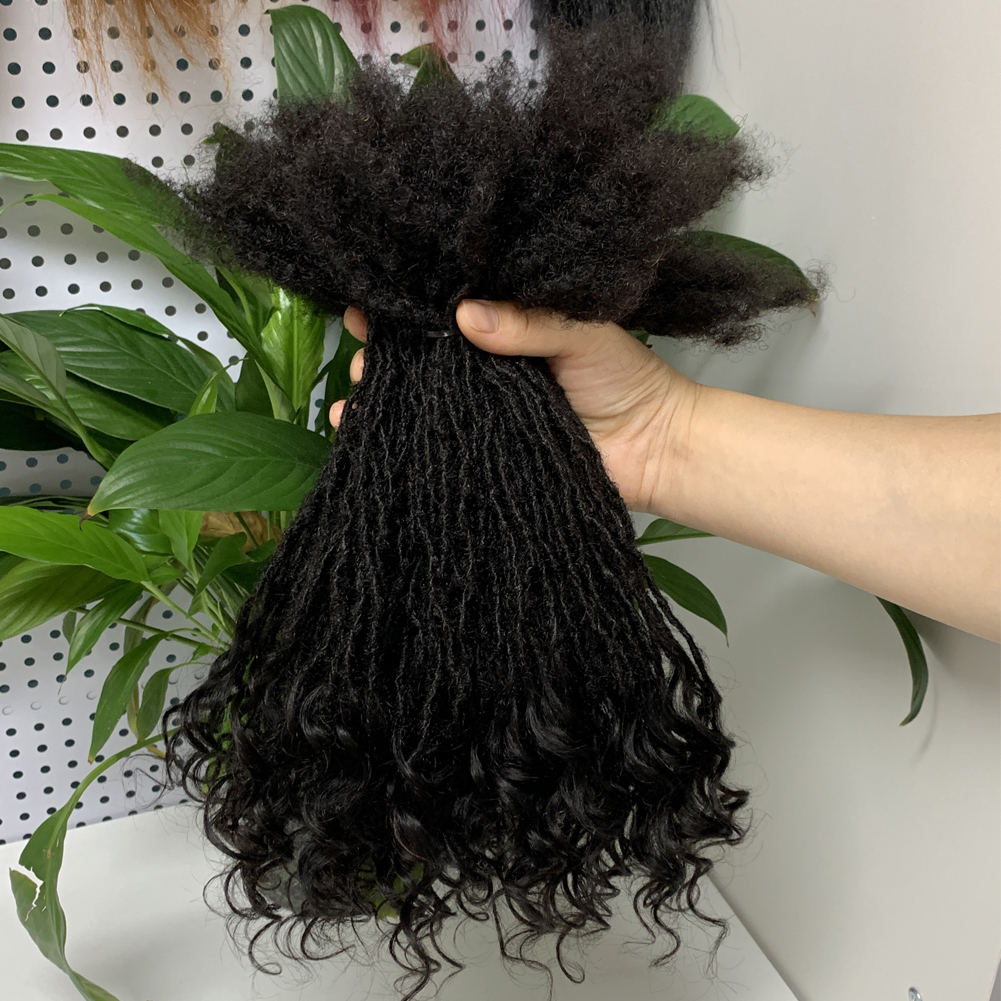
Handmade interlocked micro locs and sister loc extensions arrive already formed. The stylist's job shifts from building structure to integrating it - anchoring pre-formed strands into the client's own root grid. The structural work that used to consume the middle of the appointment has already been done at the workshop.
Illustrative model (not a quoted price): assume a stylist works 40 chair-hours per week and can complete four hand-built installations of ten hours each. If pre-interlocked extensions reduce a comparable installation to roughly six chair-hours, the same week now holds around six to seven appointments. Revenue per chair-hour is unchanged; the number of sellable hours increases. The exact figures depend entirely on your own service times and rate card - measure them before you reprice anything.
4. Pricing Around Chair-Hours, Not Tickets
Once you know your true hours per installation, three moves follow:
- Price the fast lane separately. A pre-interlocked installation is a different service with a different time cost. Price it on its own merits instead of discounting it from the hand-built rate.
- Protect the calendar. Long hand-built appointments should carry a deposit, because a no-show costs a full day rather than a slot.
- Track hours, not just revenue. Log chair-hours per service for a month. Most stylists discover one or two services quietly subsidising the rest of the menu.
Consistent gauge also matters more than most stylists expect. Extensions that arrive at a uniform diameter let you quote a realistic completion time to the client - and a realistic completion time is what makes chair-hour pricing possible in the first place.
The High-Density Microloc Revenue Suite
Handmade interlocked micro and sister loc extensions in 0.1cm - 0.4cm gauges, built for fast, uniform installations on 4B-4C natural hair.